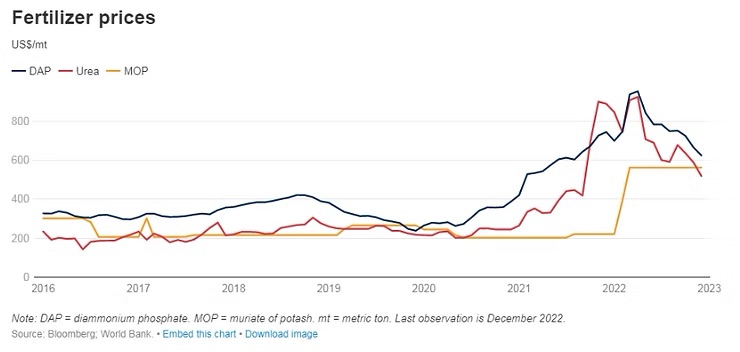
Although fertilizer prices have eased from the peak levels seen in early 2022, they remain historically high. The decline in prices partly reflects weakened demand, as farmers have reduced field applications due to issues regarding affordability and availability. The sector is also affected by supply-side constraints, such as production bottlenecks in Europe, disruptions stemming from sanctions imposed on Russia and Belarus, and trade restrictions in China.
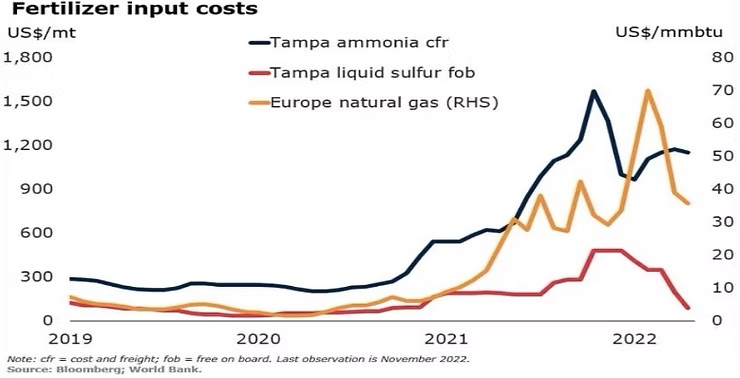
The sharp rise in natural gas prices in Europe is leading to widespread production cutbacks for ammonia, a key input for nitrogen fertilizers. As of October 2022, approximately 70% of Europe's ammonia production capacity had been curtailed or shut down. However, input costs have declined in recent months due to increased imports of liquefied natural gas (LNG) to replenish national reserves and expectations of a milder winter. This situation could enable the restart of some nitrogen fertilizer production facilities in Europe that had previously been shut down.
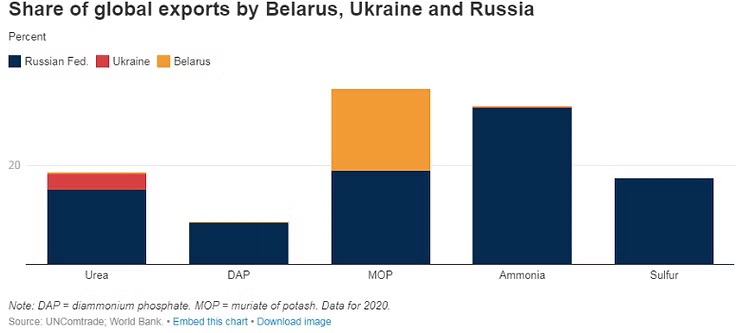
Following Russia's invasion of Ukraine in February 2022, many economies—including the EU and the US—imposed sanctions on Russia and Belarus, both of which are major fertilizer suppliers. However, these trade sanctions included "exceptions" for the food and fertilizer sectors to avoid adverse effects on global food security. These exceptions enabled Russia to continue exporting fertilizer. In contrast, potash exports from Belarus fell by more than 50% due to restrictions placed on the use of EU territory for transit purposes.
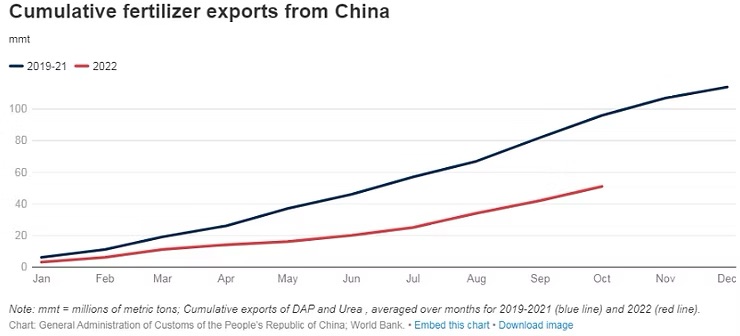
China's decision to extend restrictions on fertilizer exports—aimed at maintaining domestic availability—has heightened supply concerns. DAP exports from China, which accounts for 30% of global DAP trade, fell by approximately 50% year-on-year during the first ten months of 2022. Meanwhile, China's urea exports also declined by roughly 60% year-on-year during the same period.
In the first half of 2023, Russia sold at least $6.6 billion worth of fertilizer to the global market. Brazil, India, and the US were recorded as the largest buyers of Russian fertilizer.
According to data from the United Nations (UN) Statistics Division (Comtrade), Russian companies supplied a total of $6.6 billion worth of fertilizer to 57 countries during the January–June period of this year.
While specific details regarding some traditional buyers—particularly in Africa and Asia—are not disclosed in the databases, nearly half of Russia's fertilizer exports went to Brazil (with a volume of $1.9 billion) and India ($1.3 billion). The US ranked third, purchasing $890 million worth of fertilizer from Russia, while China's imports reached $632 million and Mexico's totaled $429 million.
Among the top 10 importers of fertilizer from Russia during the reporting period, Turkey—which spent $170 million on fertilizer—and Germany—with $151 million in imports—were included, while Serbia, France, and Kazakhstan also sourced over $100 million worth of fertilizer from Russia.
Guatemala's imports of Russian fertilizer rose to $93 million during the January–June 2023 period, while imports by Poland—a country known for its hardline policies toward Russia—climbed to $77 million. Current data also indicate that numerous European nations, including Bulgaria, Spain, the Netherlands, the Czech Republic, and Italy, continue to purchase fertilizer from Russia.
According to the Russian Federal Customs Service (FTS), Russia supplied $19.295 billion worth of fertilizers to global markets throughout last year—a volume 1.5 times greater than that of the previous year.
Ultimately, the fertilizer industry stands at a crossroads, balancing challenges with opportunities. While volatility in natural gas prices and geopolitical tensions create difficulties, innovations in production and the shifting energy landscape offer opportunities for resilience and adaptation. As the sector navigates these complexities, stakeholders must collaborate to ensure a sustainable and secure future for global agriculture.
Source: Worldbank, accessed 25.11.2023 Best regards,

SETO is a trusted agricultural brand that offers innovative solutions in plant nutrition and aims to increase efficiency in agricultural production.